If you're trying to work out how to spot a catfish, the profile photo is the wrong place to start. Test what a fake account struggles to keep up over time: a story that stays the same, a live conversation and a photo with a clean history. Then apply the check that overrides the rest: if money or a login code has come up, you already have your answer.
None of this will tell you who is behind an account, and it doesn't need to. You can walk away from someone without knowing their real name.
Catfish, romance scammer or just private?
A catfish is someone using a false identity online: stolen photos, an invented job, a life that doesn't exist. A romance scammer uses a relationship to get money. One person can be both, but a fake profile doesn't tell you the motive, and you don't have to settle that question to protect yourself.
Plenty of honest people look odd on paper. A thin profile, one old photo, camera shyness or awkward English are reasons to keep checking. On their own they aren't findings.
The four checks, in order
Start with what's free and work toward what costs time or credits. Stop as soon as the answer is clear.
| Check | What you do | Red flag | What passing doesn't prove |
|---|---|---|---|
| 1. Story | Ask ordinary, specific questions and compare the answers over time | Details shift, or a job conveniently explains why you can never meet | That they are who they say they are |
| 2. Live contact | Suggest a short voice or video call at a time you pick | Endless excuses, or calls only on their terms | That the rest of the story is true |
| 3. Photo history | Run a reverse image search, then a face search if you need one | The same face under another name, or on a stock-photo or scam-report page | That the profile is genuine. No matches proves very little |
| 4. Money and codes | Watch for any request for money, gift cards, crypto, investing or a login code | Any request at all from someone you haven't met | Nothing. It only means the request hasn't come yet |
Read the last column before you relax. Passing one check removes one doubt and leaves the others where they were.
Check 1: Does the story hold up?
A real life produces small, checkable details, and an invented one tends to stay vague. Ask about ordinary things: what their commute is like, what's near their office, what they did last weekend. Bring one up again a week later and see whether the answer still matches.
Pay close attention to any story that explains why you can never meet. The FTC's romance scam guidance lists the usual ones: living or traveling abroad, working on an oil rig, serving in the military, or working for an international organization. It also suggests searching the person's job plus the word "scammer" to see whether others have reported the same story.
Don't ask for ID, a home address or bank details to settle your doubts. A stolen document answers that request just as well as a real one, and you'd be collecting a stranger's private data.
Check 2: Will they talk to you live?
Suggest a short voice or video call at a time you pick. Repeated excuses matter more than one missed call, especially when every cancellation comes with a new crisis.
A call used to feel like the end of the matter. In a December 2024 warning, the FBI said criminals create AI videos for private conversations to "prove" an online contact is a "real person", and generate videos for real-time chats while posing as company executives, police and other authority figures. Its advice is to look for subtle flaws such as distorted hands or feet and unrealistic teeth or eyes.
Spotting no flaws doesn't clear anyone, and a perfectly real face can still come with a false name and a false plan. Treat a call as one more piece of evidence. People also turn down calls for ordinary reasons, including privacy, disability and safety, so a single no isn't a finding either.
Check 3: How to spot a catfish from their photos
Search the photo and look for a different name attached to the same face. The FTC recommends a reverse image search of the profile picture, and says a photo tied to another name or to details that don't match is a sign of a scam.
Start with Google's image search, which is free. On a computer, open Google, click the search-by-image icon and upload the picture. Results can include websites that carry the same or a similar image.
A reverse image search matches pictures. A face search matches the face, so it can surface a different photo of the same person. Face Lookup's catfish photo search works this way and lists stock-photo and scam-report sources first, since those answer this question most directly. Upload one clear JPG, PNG or WebP, up to 5 MB, that you have permission to search. Each search needs an account and costs 3 credits, even when it finishes with no matches. The submitted photo is kept privately for 30 days. The search covers public web sources and cannot see private accounts.
Then read what comes back:
- Same face, different name. Open the page and compare the picture, name and date. The person pictured may have had their photos stolen, or may simply look similar.
- A stock-photo or portfolio page. A strong hint that the portrait wasn't taken for this profile. Confirm it really is the same image.
- A scam-report page. Read what the report says and when it was written. It may describe the account you're talking to, or it may only reuse the photo.
- No useful matches. This proves very little. An AI-generated face has no original online to find, and the FBI says criminals create realistic images for fake profiles.
A similarity score isn't a probability that two photos show the same person, so open the source before you conclude anything.
For the upload, crop and result-review process, see our photo-search video guide. It uses an AI-generated fictional portrait to show why returned faces and similarity scores are leads to examine, not identity confirmations.
Check 4: Has money come up?
If someone you've never met has asked for money, you can stop here. The FTC's rule has no exceptions: "Never send money or gifts to a sweetheart you haven't met in person."
The agency describes trust built quickly, often through chats several times a day, before the first request. That request is usually framed as medical bills, a plane ticket, a visa or a fee to get out of trouble. Some skip the emergency and offer to help you invest in crypto. Payment gets steered toward wire transfers, gift cards, money transfer apps or cryptocurrency, which are hard to get back.
Treat a login code, bank access or an intimate photo the same way you'd treat cash.
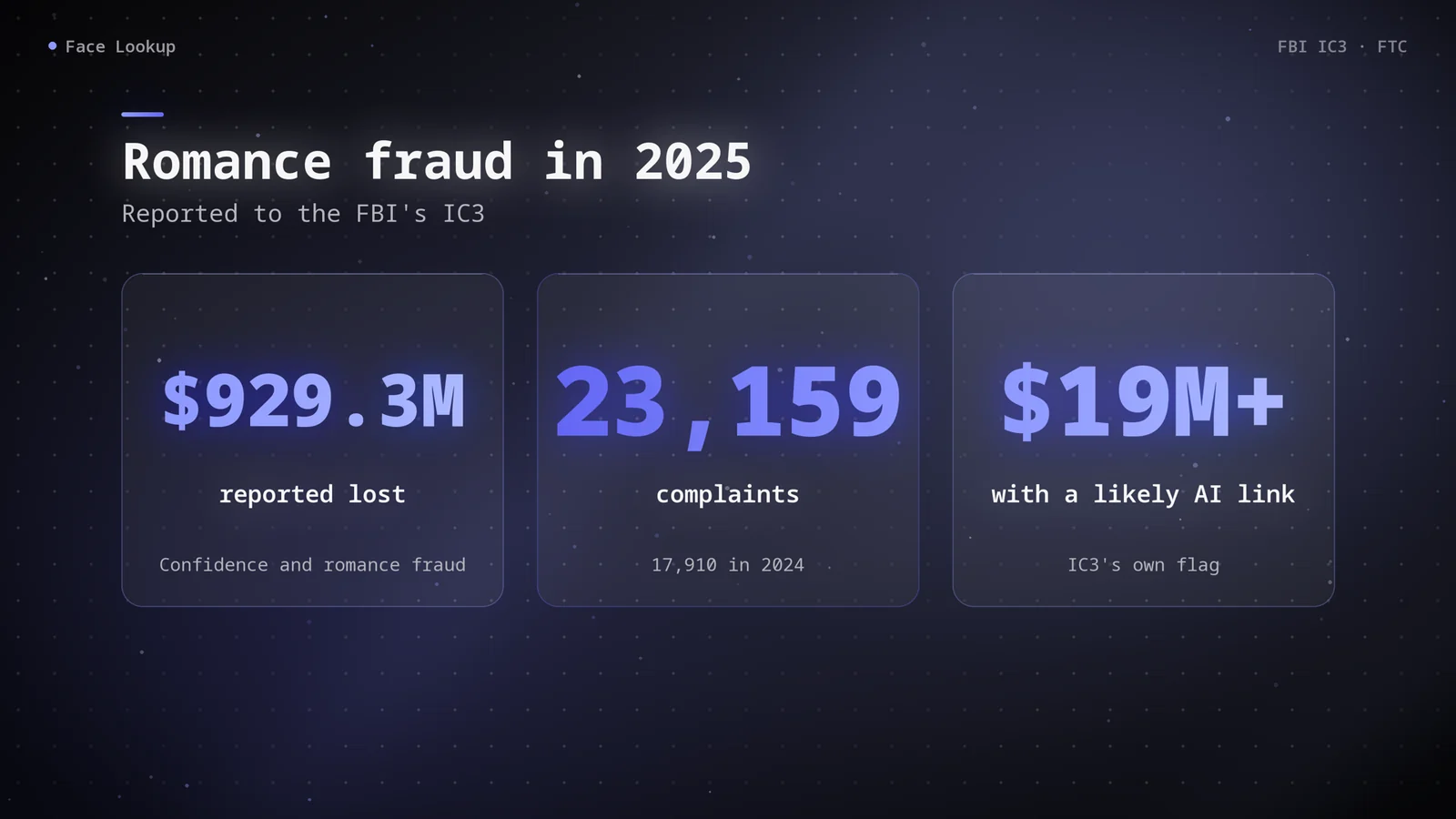
The FBI's 2025 Internet Crime Report counted $929.3 million in reported confidence and romance fraud losses across 23,159 complaints, up from $672 million in 2024. AI gets most of the attention, yet a little over $19 million of that total carried a likely AI link in IC3's count. Reports can miss AI use, but the old script clearly hasn't gone away.
Catfish on Instagram, Facebook and dating apps
Don't save your caution for dating apps. According to the FTC, nearly 60% of people who reported losing money to a romance scam in 2025 said it started on social media.
On social platforms, look at how the account behaves. Does it have a history? Do real people interact with it? Did a friendly comment turn into a private chat very quickly? If the photo is the open question, Face Lookup has search entry points that put Instagram or Facebook sources first. Other sources stay in the results and the same limits apply: public pages only, and a match still isn't an identity.
If someone pushes you off the app early, stay put for a while. Moving isn't proof of anything, but the original platform keeps its reporting tools and your message history.
What to do if a check fails
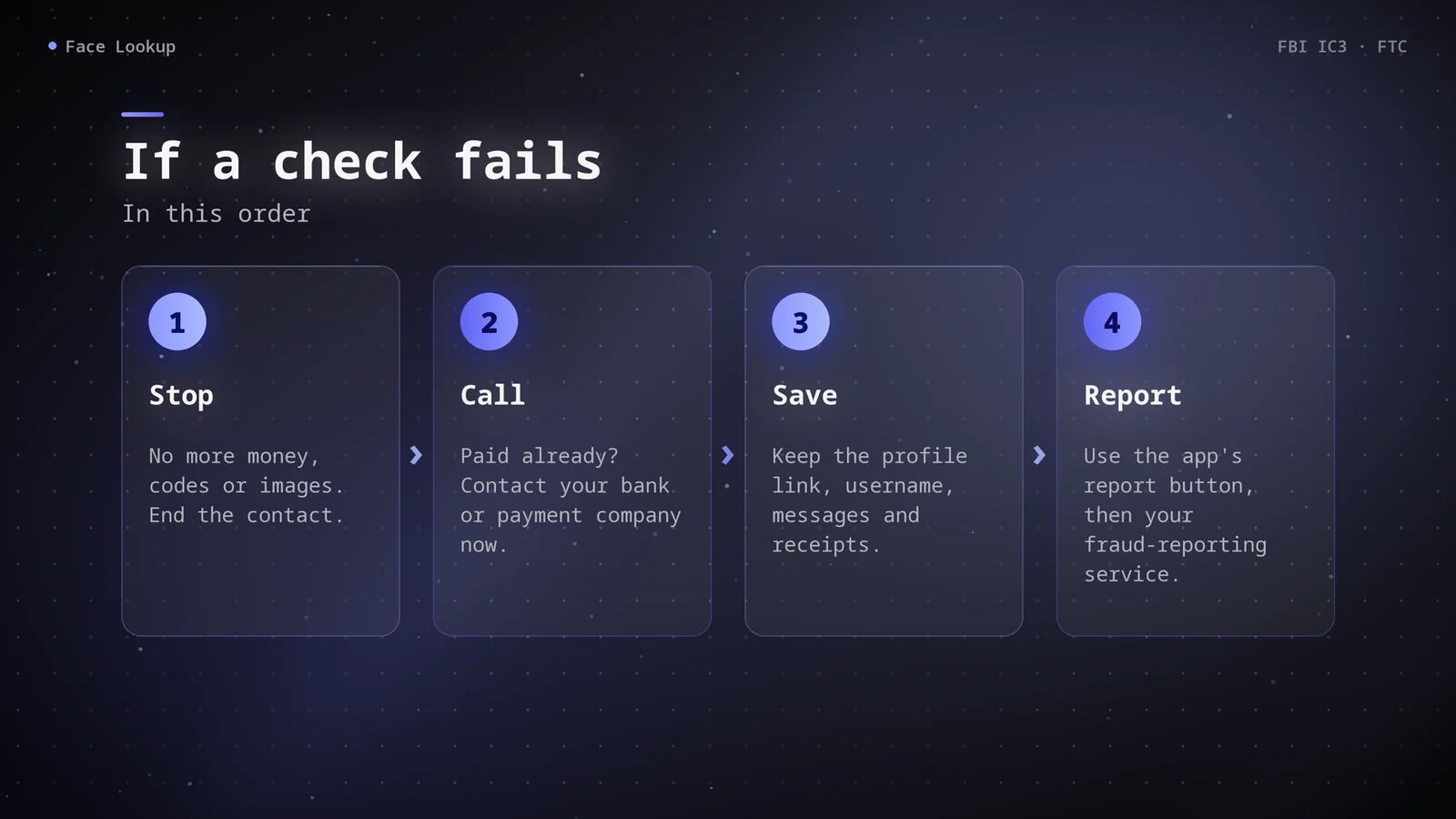
Stop first. The FTC's advice is to cut off contact right away. You don't owe an explanation and you don't need to win the argument.
If you've paid, call straight away. Contact the bank, card issuer, gift card company, wire service or crypto exchange you used and ask whether the payment can be reversed. The FTC sets out the steps by payment type and notes that cryptocurrency payments don't have the same legal protections as credit and debit cards.
Save what you have. Keep the profile link, username, messages and receipts, and keep them private. Posting a stranger's face next to an accusation can hurt someone whose photo was stolen.
Report it. Use the report option in the app or site where you met. In the US, file at ReportFraud.ftc.gov and with the FBI's IC3. Elsewhere, use your country's official fraud service or the police.
Then tell someone you trust, which is also the FTC's suggestion. A friend can see what the conversation made hard to see. Be wary of anyone who offers to recover your money for an upfront fee.
Questions people ask next

Can I find out who the catfish really is?
Usually not, and you don't need to. A photo search can show where a face appears, but the person pictured may have nothing to do with the person typing. Leave identifying the operator to the platform or the police.
What if my own photos are on a fake profile?
Report the account to the platform as impersonation and keep the link and screenshots. If people you know were contacted, tell them directly so nobody pays the impostor.
Should I confront them first?
You don't have to. A confrontation can invite more pressure or threats, and you're unlikely to get a reliable answer. If you want to talk it through, do that with a friend.
How much does it cost to check a photo?
A reverse image search through Google is free. A face search on Face Lookup costs 3 credits, and a search that returns no matches is still charged. Credit packs are listed on the pricing page.
Before you reply again
How to spot a catfish comes down to order: check the story, ask for a call, search the photo, and treat any money request as the end of the test. Pick the check you haven't run yet and do it before your next message. If money has already come up, go straight to the steps above.
Want to check a photo? Open catfish photo search.
Sources: FTC: What to know about romance scams · FTC: What to do if you were scammed · FTC Data Spotlight, April 2026 · FBI IC3 alert on generative AI, December 2024 · FBI IC3 2025 report · Google: Search with an image. FTC and IC3 reporting channels are US-specific. Face Lookup provides photo-search leads, not identity verification, a background check or a finding that someone is a scammer.